
If you’re anything like me (or even if you’re not) you woke up this morning feeling pretty disheartened. It’s been a rough few months. And as I thought this morning about what Fangirly’s response should be, none of my ideas were really in keeping with the upbeat and positive tone that Ellen and I have hopefully cultivated here. So I eventually decided not to focus on events that I found disappointing, but rather to emphasis people in pop culture who represent the kind of world I want to live in. And because 2016 has been a incredible year for women in pop culture, I decided to inaugurate (get it?) a new annual feature: Fangirly’s Inspirational Women of the Year. Some of them are fictional, and some of them are flesh and blood BAMFs. You’ll notice that this list won’t be a patent pending Fangirly Top Ten. That’s because, unlike our dear President Elect, Fangirly doesn’t believe in ranking women on a scale of one to ten. So without further ado, Fangirly Presents the Bad-ass Broads of 2016.
Rey (Star Wars: The Force Awakens)
After the release of The Force Awakens, Fangirly wasted no time in gushing about the galaxy’s newest Jedi-Jane. She’s tough and smart, and we salute her. In the film’s 138 minute run-time, she managed to save the galaxy and make knee-length harem pants look cool. It’s genuinely difficult to say which of those feats is more impressive.

Malala Yousafzai (He Named Me Malala)
Although Davis Guggenheim’s documentary about activist Malala Yousafzai came out in 2015, it didn’t reach most American audiences until 2016. Not that Fangirly feels that they need to justify adding Malala to any list that includes the catch-word “inspirational”. If you haven’t gotten around to seeing He Named Me Malala, you’re probably not alone. But with Islamophobia on the rise in this country, it might behoove you to do so. It’s the true story of a young Muslim girl who spoke out in favor of educating women, putting her in opposition of the Taliban. Here’s a video of 16 year old Malala’s address to the UN in 2013.
Wonder Woman (Wonder Woman)
After her turn as the most watchable part of Batman V. Superman, DC released trailers for the Wonder Woman movie, set for release in 2017. Wonder Woman has been a feminist icon for decades, and her stand-alone film is a stride long overdue. Please enjoy this perfectly bitchin’ piece of pop culture history.
Winona Ryder (Stranger Things)
After years away from the spotlight, Winona Ryder returned to the screen in Netflix’s Stranger Things. If you haven’t binged Stranger yet (and I promise, binging is the only way to go), you’ve not only missed one of 2016 best shows, but also one of it’s best performances. Winona, in the words of Veronica Sawyer, you’re beautiful. Only, in this case, we actually mean it.

Beyonce Knowles
Because, duh.

Ellen (Of Fangirly.com)
This year alone, Ellen moved cities, jobs, and wrote a hit web-series, The Cate Moreland Chronicles. She was an inspiration to me this year. Get it, girl.

Peggy Carter (Agent Carter, Captain America: Civil War)
2016 marked the last time we will most likely see Hayley Atwell’s iteration of Peggy Carter on screen, and it’s a loss that we feel already. Peggy was the embodiment of smart, strong women in a male dominated field. She was a reminder that if women everywhere can learn recognize their own value, we’ll get that patriarchy slayed in no time.

Hillary Clinton (The 2016 Pre-Apocalypse, I Mean, Election)
Whether or not you agreed with her policies or trusted her judgement, this woman has done something amazing. She is the first ever woman to be nominated by a major political party in the United States. She’s worked her entire adult life to open that door, and thanks to her, one day a woman will walk through it. Thanks for reminding us that women are more than just a p#ss to grab. You may not be my president, but you are one Nasty Woman.

–Whitney Weldon


 grown-ups, for grown-ups. And what if the increasing commercial success of R rated movies causes this trend to spill into other genres?
 wouldn’t be bothered. But I think we can all agree that superhero movies, from either side of the Marvel-DC partisan line, are getting progressively darker and, much as I hate to use
 America franchise has delved deeper into that dark, self-aware realism that has made the sequels so surprisingly wonderful? As an adult audience member, I’m loving it. But I’m not the only demographic at whom these movies are supposedly aimed.
 America: The Winter Soldier? Or, maybe more to the point, should you? These movies are starting to delve into themes and employ levels of violent realism that kids like Jack just aren’t ready for. And yet these movies, and all their must-have merchandise, continue to be marketed to him.
 Most superhero movies (actually, most movies in general) are more than willing to do the ethical legwork for you. The bad guys (easily distinguished by facial scars, a dark color pallet, or customary bad attitude) are always wrong, and the good guys (identifiable by their steely-eyed commitment to the greater good and general dishy-ness) are always right. Even those films that dip their toes into moral relativism always eventually find their way to the safer, more solid narrative ground of Righteous Hero v. Dastardly Villain. But what happens when everybody looks like a good guy? What is expected of us as an audience when everyone’s actions, including the guy in spandex we came to see, can be understood as right or wrong? For once, maybe the question of morality is open to our interpretation.
 you’d expect: good guys going after bad guys. But when the good guys (here represented by Cap, Black Widow, Scarlet Witch, and Falcon) make a mistake with fatal consequences, there is a global outcry for a little accountability, in the form of UN sanctioned panel that would oversee the Avengers from here on out. Some, like Iron Man, Black Widow, and Vision, see this as a necessary compromise. Others, namely Cap, Scarlet Witch, and Falcon, see it as an undermining of what the Avengers are supposed to be- a group a super friends with the autonomy needed to keep the world safe from handsome alien conquistadors and shapely, artificially intelligent robots. The result can only be described as a, ahem, civil war.
 If you’re worried that this movie sounds too much like a talky political drama, rest easy. Civil War has even more than the usual amount of ass-kicking. But what’s really cool about this movie is how the Russo Brothers managed to take out almost all the cartoonishness of superhero violence. There’s a scene, pretty early in the film, where Captain America falls from a ledge and gets beaten around like a rag doll before making an uncharacteristically graceless landing. And, even more surprising, he doesn’t immediately bounce back. Right away we get the feeling that, in this film at least, violence has consequences. And unlike many other action movies of it’s kind, it feels as though the fight scenes are built around the set pieces, and not the other way around. The characters have to adapt to and use their surroundings in a way that makes the idea of a super-soldier and a guy in a cat-suit going at it feel a little more grounded.
 everything I want to say can be summed up in one onamonapia: meow. Seriously, don’t change a thing.
 go along for the ride. You feel obligated to choose a side, and for once, it might not be the same side as the guy with his name on all the posters. Right and wrong is a matter of perspective and actions have far reaching consequences. Does that sound a little familiar?


 Mom and Dad, if you’re reading this (safe bet), you should know that I went to see this movie under the falsest of pretenses. See, I thought Deadpool was about a ghost who throws a pool party for his friends. Imagine my surprise! I honestly wasn’t expecting the gratuitous violence and the foul language and the annoyingly brief glimpse of Ryan Reynolds’ junk. Suffice it to say, not my cup of tea. Anyway, I’m now going to launch into a very lengthy dissertation on how Billie Piper is, in many ways, a more well-rounded performer than her American counterpart, Britney Spears. So, you’ll probably want to leave off right here. Bye… love you… go watch Castle for a while…
 experiment gone sideways. He’s gotta get his girl (Morena Baccarin) and put the screws to some bad guys, not necessarily in that order.
 sexualized and whose character arc doesn’t ultimately lead her on a quest for romantic fulfillment. Calling a woman in TV “complicated” is shorthand for saying that she has a dark past. Calling her “strong” is another way of saying she’s emotionally unavailable. These have become the hallmarks of an empowered and sexy woman on TV.


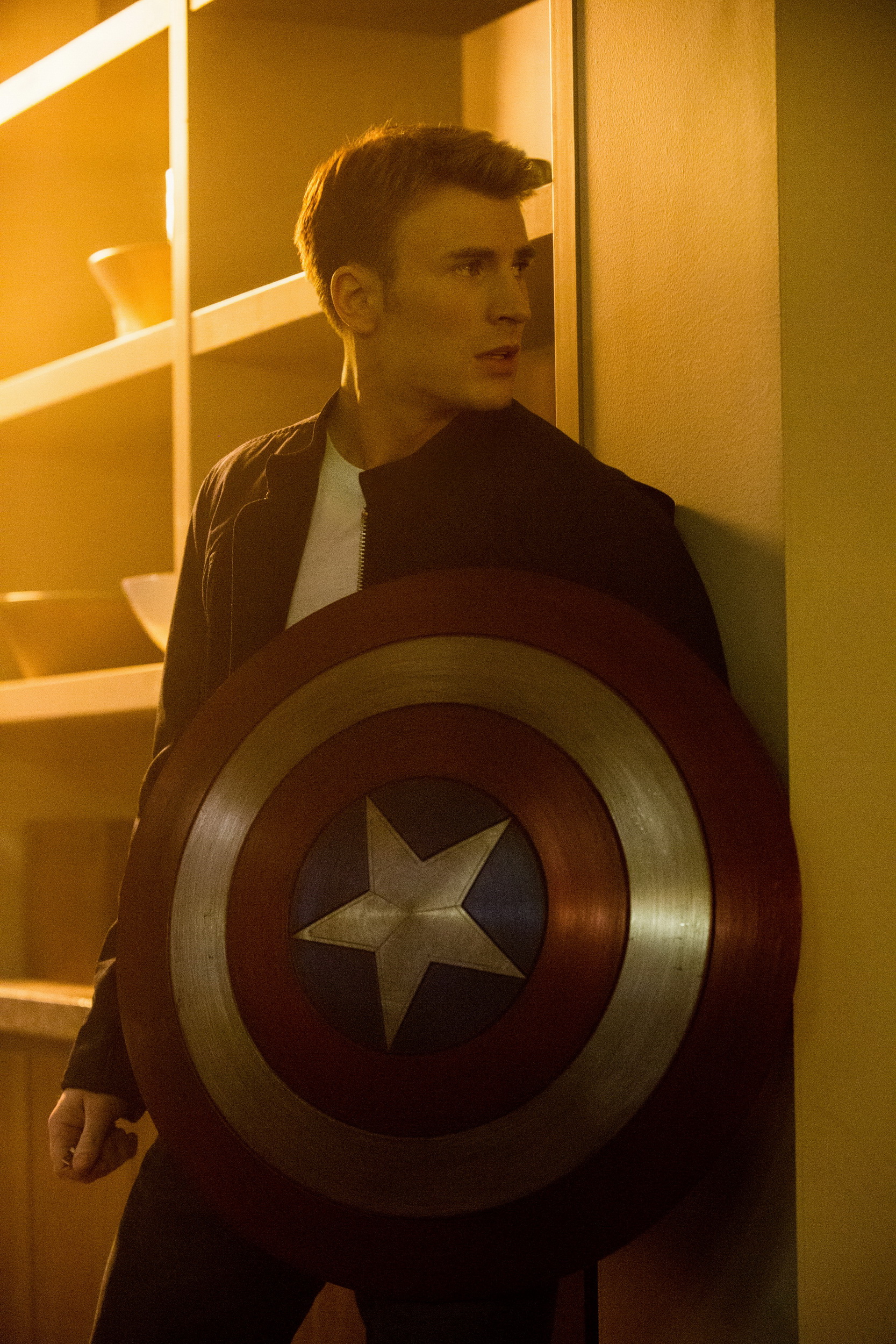
 In a nutshell, Cap learns that SHIELD may not be entirely on the up and up, even for a subversive spy organization. That’s his real conflict; the titular bad guy is more of a complication. A super, super hot complication.

